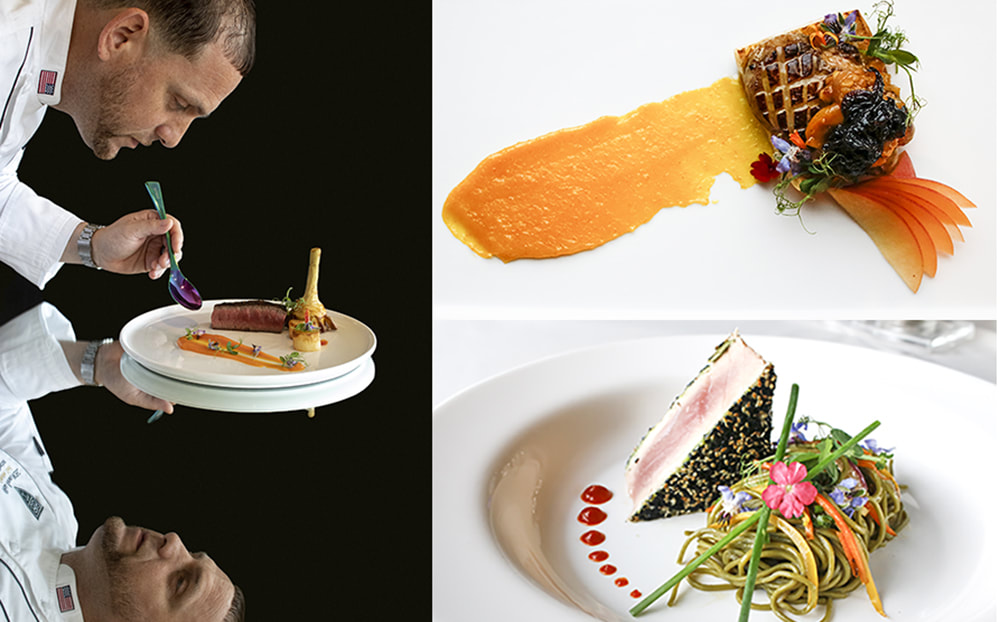
 Chris Reveron, Culinary Director and Executive Chef at Bonnie Briar Country Club, Larchmont, New York, USA Image top right: Pan -seared Foie Gras with Spiced Citrus Puree, Tomato and Peach Compote, Red Onion Jam and Brioche Toast. Image bottom right: Wasabi and Sesame Crusted Tuna with Green Tea Soba Noodles, Julienne Vegetables and Sesame Garlic. Images by Diana DeLucia I had always wanted to get to know Chris Reveron a little better. I met Chris in September 2019 at the second annual Golf Kitchen Culinary Excellence Awards at GlenArbor Golf Club, Bedford Hills, New York, just before the Pandemic. The more I learned about Chris, the more I wanted to know. I followed his LinkedIn account and quickly realized how he championed others before himself. Even when producing this profile, he insisted on including his kitchen family; he wanted them to share the experience. Chris is a veteran who did several years in Iraq and returned with the often-overlooked PTSD. I was intrigued by how Chris found his way into the culinary world and how his childhood and military experience led him to the industry. ~ Diana DeLucia GK: Tell us a little about your childhood. I was born in Bridgeport, Connecticut. My mother is from Portugal, and my father is from Puerto Rico. Bridgeport is a crazy town to grow up in, and I survived the public school system. My parents were dealing with addiction issues, and I grew up quickly. I continually searched for a male figure to help me steer my ship. That person was my uncle from my father’s side, a Culinary Institute of America designated ProChef III. He was the sole reason I decided I wanted to become a chef at a very young age. He passed away in April 2020 due to Covid-19. He was one of the first 75 people in Connecticut to die from the virus. I will never forget the day he made a red sauce with clams, mussels, and calamari. I was eight years old. I was there helping him and eating. My uncle could not believe that an eight-year-old was eating clams and mussels, and from that moment, everything changed; he began to bring me to freelance jobs he did so I could help with minor tasks. When I was 11 or 12, I began working with him at a medieval festival in Wilton, Connecticut. I loved every moment, and he paid me 50 bucks to peel the onions and potatoes! After that, I hosted the event with him for ten years. After I left grade school, I went to Bullard Havens Technical High School in Bridgeport; the primary trade I chose was culinary arts. And the professor there was the professor who taught my uncle! Like my uncle, I was the class clown. I loved to laugh and have fun; it was my way of hiding a lot of the pain from the past. In my junior year, around 2000, I enlisted with the U.S. Army under the delayed entry program and began training at Ft. Leonard Wood, Missouri. They offered the opportunity to join the military at 17 years old and sent me off to basic training after my junior year during my summer break, with my parent’s consent. I soon enrolled and began military training in the 110-degree weather. When I returned, I completed my senior year of high school and trade, graduated with a 92 average GPA, and was at the top of the class in the culinary program. After high school, I went to Fort Lee, Virginia, for my military occupational job training, a 16-week course. I was a food service specialist when I began to cook for two-three thousand people. That is where I mastered banquet cooking! After that, I joined The Reserves. In 2001, I landed my first chef job at The Patterson Club in Fairfield, Connecticut. GK: Why a country club? When I got home from Fort Lee, Virginia, a friend worked at The Patterson Club. They had a server position available, but I wanted to cook. He spoke to the chef, and I got a job. I loved it, and I was there for ten years and began to rise through the ranks. From February 2003 to March 2005, I had to take a military leave of absence because I was mobilized to Iraq. In Iraq, the cooking was all contracted by Halliburton and similar government contracting companies; thus, I had to cross-train as a fuel service specialist and heavy wheel operating mechanic. We were a tier one combat unit delivering fuel. I was there 25 months total, and we delivered fuel for 19 months. We supplied 85% of the fuel for that war, and we pumped about 13 million gallons of fuel a day. If you are a veteran and traveled through Iraq from February 2003 to March 2005, there was a 95% you got fuel from us. When I came home, I went back to work at The Patterson Club and stayed until June 2010. I was the executive sous chef when I left. GK: Where did you go next? Joe Napolitano was a big piece of fuel for me to push myself. He had told me about a position available in Rye, New York, at a club named The Apawamis Club. He told me that the job would be a step-down in the short term, and I would have to take a pay cut. Joe has never given advice to me that placed me in the wrong direction. He urged me to take the position for the long-term growth potential at the prestigious Platinum Club. It was the right decision and has led me to where I am today. On that note, with his leadership qualities, Joe has been a catalyst for my professional growth and development. I started as the grill cook and began learning about the club’s stature and what it could offer in the future. Joe left the club three years later to become a general manager in Larchmont. This was when things became a challenge for me. I was ready to take on the executive chef role, but it would not be smooth sailing. The club decided to interview multiple candidates, which was a very emotional time for me. I had a conversation with the club president, who was concerned I might leave, and I told him, “If you won’t place me in the executive chef role, then at least please hire someone more qualified than me so I can learn from that chef. Someone who can teach me. I will sign a contract and stay with you if you are willing to do that.” That night, I was 28 at the time; they called me into the office with a yellow folder and announced that they had found a new executive chef. I said, “I am sure you guys made the best decision for the club, and I am looking forward to meeting the person you all hired as the executive chef. SIDENOTE: I don’t think people understand because of the way I grew up, the military, and the PTSD that resulted from that; when the president looked at me, my eyes were watering. I had two children and a wife, and my childhood flashed before my eyes in that very moment. I always asked God not to put me in a place where I had to relive my trauma. Everything I endured, the sacrifices and many missed occasions, this was the moment I went through all of it. GK: What happened next? After the anxiety and flashbacks I was experiencing, to my surprise, they told me I was the new executive chef and asked me if I wanted to take on the role! I thanked them all, accepted the position, and signed a contract the next day. In my first-year review, I got a raise that I would have never imagined! I was never greedy for money; I was taught that when you chase money, you chase the devil. A former sergeant in Missouri told me, “I’m going to leave you with this statement. Remember, money will always be made, but time will never be replaced.” That is what’s pushed me today to do a lot of community service work with inner-city schools and public speaking. I share my story because we’re so caught up in the social media dilemma, a world many people base their lives on, and I feel I am in a position today that giving back to my community is of the utmost importance. GK: Tell us about your community service work. I work with children and teenagers; they all know we need money to survive and eat. I embarked on a journey with Feeding Westchester and Pastor Pasquale, who oversees the program. I’ve worked with Pastor Pasquale for some years and am still involved with the program today. In 2021 my team and I provided over 10,000 meals for the food insecure in Westchester County! During the Pandemic I decided to bring my kids along with me to Kingdom Life Christian Church in Milford, Connecticut, our church we attend. I sat with Pastor Mike, and we decided to start cooking soup every Monday with my kids. I wanted them to understand the importance of giving back and feel good about doing it. We had a couple of houses we’d drop soup off to, and my kid’s found excitement in doing so every week. These are the moments of facilitation that go further than a paycheck. GK: How did you land at Bonnie Briar Country Club? I was the executive chef at Apawamis for eight years when a new opportunity came about at Bonnie Briar Country Club. I wanted to take on a new and challenging role, and once again, it was Joe Napolitano who challenged me. Joe Napolitano, my former boss, was now the general manager at Bonnie Briar. I will be taking on the executive chef and director of food and beverage role after my friend and colleague Matt O’Connor left the position to take on the culinary director position at Wee Burn Country Club. GK: Tell us what your plans are at Bonnie Briar. I am working on programs to make the culinary department at Bonnie Briar sustainable. I am slowly rebuilding the kitchen and adding new equipment. The membership mentality is changing, and the younger members support our actions. I hope younger members support our actions. I hope within the next couple of years we can build a new kitchen. GK: Tell us about the younger members. Younger members are coming in from midtown, uptown, and downtown Manhattan. They joined during the Pandemic, and they played golf and dined here. They value dining at the club as a social element as much as golf. I try to keep our dining above the level of the local restaurants so that we can compete. When the vice president at Bonnie Briar interviewed me, he said, “You make this program yours.” I’m going very slow. I don’t go in with an iron fist, and I never would. Memorial Day 2022 was my single-handed busiest day in a club in my 20-plus years of service; we did 299 a la carte lunch meals in two hours and 14 minutes! The following week the members said, “Chef, how did you put all that food out? I said, “In the kitchen it’s all about what the team and I do operationally; a few key factors help everybody succeed. The first is the organization’s personnel, the second is purpose, and the third is the intuition of the team. With those three facets, if you can narrow that down, operations quickly become seamless and effortless.” GK: What are your long-term goals? My long-term goal is to become a general manager. My heart will forever be in cooking, but I believe God has different plans at another level for me. My life has been filled with challenges, trials, and tribulations, just as everyone’s has, but this is my journey, and I must own what I want. Every journey is a lesson, and my path has been teaching me to continuously grow no matter what. I have such a following now with people in the industry, and I’m learning every day. I surrounded myself with great people and mentors over the years, and I believe the culinary operations will be in the limelight of private golf and country clubs nationwide very soon. GK: I spoke to a colleague of yours Charles Dorn of the Dorn Group about your friendship and he had this to say. Chris is the antithesis of many traditional chefs. People and family first. Kitchen is family. Passion beyond 98% of people I know. Pride in his product. Loyalty to the military. What a great answer from a colleague and friend! GK: What are your thoughts on such great praise from Charles? When Joe left, Charles was hired as the headhunter to find an executive chef at The Apawamis Club. Charles has always been a dear friend since my appointment at the club. When I went through the interview process, he was always there. After I was hired, we never lost communication, and we have remained in contact ever since. I am grateful to Charles for his kind words. GK: What advice do you have for other veterans, chefs, culinarians, or anyone with PTSD? The only advice that I can give is to follow your dreams. Sometimes we caught up in the moment without thinking about the future. We live in a world that’s fast-moving, slow down, think and make calculated decisions. I believe from where I come from that I am an example for many kids in Bridgeport, Connecticut. Not too many people make it as far as I did, but I thank God every single day! Cook with your heart and not your ego! Always remember, what a canvas is to an artist is what a plate is to a chef. Lead with emotional intelligence at the forefront and purpose as right behind. For those that suffer from a disease we know as PTSD, you are not alone. SPEAK, reach out and know your resources. It’s too often we get lost in our problems from the past and forget we have avenues to help reduce that pressure. You are only as alone as you allow yourself to be, and I’ve been there. What I have learned is that we all have a story, but it’s how I interpret mine, is what got me to a safe mental space and where I am today. I will say it’s when I redirected my life to God that things really started to fall into place for my family and I. Although I had a rough upbringing, I thank God every day! I thank him for allowing me to travel the roads I had to, as it prepared me in a big way for what was to come. Although my parents had circumstantial addictions, my mother was always my air! I had a stepfather that we all knew as “Hun”. My friends and all the family all called him Hun. His name was Edwin, and he was the most AMAZING DAD any kid could wish for! He had no kids of his own but taught me how to love and always put family first! Any man can father a child, but not every man can be a dad... He was the example. I tell you this because God will put people in your life to teach you lessons. I lost him on Christmas morning 2018. I would not be the father or Husband I am without having him in my life. I have two little girls that my world revolves around. This business is tough to be in when you have kids but placing boundaries in line for important things is a must. My little ladies love to cook with their papa! They are now 11 and 9, but they began cooking from a very early age. My wife of 10 years now has been a pillar to my success. It’s not easy being a mom while dad is working 60–70 hour work weeks, but she rode the wave with me. Raising the kids while working and coming home to work another 40-hour week with the kids is draining, and I will forever be grateful to her for that. One thing we promised is never to be too busy for family. We’ve been together for 17 years now, and I told her from the beginning how much I loved cooking, and if she couldn’t deal with the crazy hours, I was likely not the guy for her. I guess she took the challenge and ran with it, and we now have two little ladies to be a part of the Reveron family. GK: Tell us about your team. As I look back at the earlier years of my career as a young executive chef, I realized very early on that strength comes from the people you surround yourself with. 15 years ago, Jose Sanchez joined me on my culinary journey. He was very green but eager to learn. He is one of the hardest working, dependable, driven individuals I have worked with. Fifteen years later, his drive, work ethic, and dependability remain. Jose Sanchez is now the executive sous chef at Bonnie Briar and a very dear person to me. His cooking and banquet department strengths are far beyond the average chef’s. His passion for this craft is unparalleled to many. Jose has demonstrated superior work ethics over the years and has what it truly takes to grow in this industry. Particularly impressive is Jose’s readiness to contribute to the morale level in the kitchen when there is time to have fun and his ability to differentiate between those times when absolute focus and seriousness is required. He worked extremely hard to earn his title and, more importantly, the respect I have for him professionally and personally. I know one day he will make a fine Executive Chef and be a great mentor to those around him. Thank you, Jose (who we all in the kitchen call Macho), for all your hard work, sacrifices, and determination to constantly win! Catherine DiQuinzio is the next person who has a special place on my team. This young lady is the definition of a true professional. She has her Associate of Applied Science in Culinary Arts and Management from Westchester Community College and her Bachelor of Professional Studies in Hospitality Management from the New York Institute of Technology. Catherine joined me at my previous club as a seasonal snack bar cook. She juggled school and work during the summer months with ease. Once Catherine graduated with her AAS degree, she wanted to work full-time and learn. She rose through the ranks and continued showing determination in her work and studies. I worked around her schooling when she went back for her bachelor’s degree, and she now is the Chef de Cuisine at Bonnie Briar. Her work ethics, talent, and professionalism are exemplary for any young professional. I contend that Catherine represents the best any young professional can offer an employer. Catherine can quickly gain a clear understanding of any set of directions given to her; no task has ever proven to be beyond the realm of her capability. Catherine is a rising star in the hospitality industry, and anyone who fails to see a talent at this level is plain blind. Thank you, Catherine, for all you do, and I can’t wait to see what plans God has in store for you. Matthew Marrero was the needle in the haystack back in 2020 when I hired him. He came into my office for an interview, which was a great conversation. I instantly knew there was something about him. He was hired as a PM sauté chef. During his first week, it was clear that he wanted to go places. As 2020 went on under the pressure of the world’s Pandemic, I witnessed what Matt was capable of and how he breathed the trade; I wanted to help him grow. We quickly bonded, and he became a part of the culinary department’s “blueprint.” Behind the line, he’s as calculated as an eagle diving for a meal on busy nights. I sat him down and asked, “What do you want to do with yourself in this business?” He responded, “I want to learn from you.” It was then I knew what the next phase for him was. I had Jose and Catherine generate a plan of action for his growth and bring it to me. We went over everything and put it in play. Fast forward to late 2022, and Matthew is now a Sous Chef with the team/family. Jose and Catherine are a massive part of his development, as I made it a point for both to take the lead with Matt. These three Professionals one day will phase into more significant roles, and whatever company they are with will be lucky to have any of these three as an asset in their company portfolio of professionals. 
1 Comment
 First-Time Cover Showcases Multiple Chefs and Taste of Golf Fundraiser. New Haven, CT – The philanthropy issue of Golf Kitchen, the highly-regarded, luxury brand that celebrates high-end club culinary experiences, is now available for pre-sale. The beautifully produced magazine is targeted to chefs, purveyors, general managers, and culinary aficionados. The cover story highlights 11 chefs who participated in Taste of Golf, a fundraiser for the North Florida chapter of First Tee held at TPC Sawgrass in Ponte Vedra Beach. Additional stories showcase the Berenberg Invitational, held at GlenArbor Golf Club in Bedford Hills, New York, which raised $1.4 million for the Nebraska Pancreatic Cancer Center of Excellence; and the ClubsHelp Foundation Inc., which recently joined forces with Eagles For Children (EFC) in a collaboration aimed at combining resources to create a greater impact.  A vibrant travel feature spotlights Italy, where the eyes of the golf world will be focused on the 44th Ryder Cup Matches this fall. Brae Burn Country Club (Purchase, NY) is the showcase club and Executive Chef Thomas Isidori provides four mouth-watering recipes.
Since 2014, Golf Kitchen founder, Diana DeLucia, has chronicled private golf and country clubs, shining a light on the quality of their culinary offerings. The Golf Kitchen portfolio includes a quarterly magazine, books, special culinary events, and the Golf Kitchen Culinary Excellence Awards, an annual event at GlenArbor Golf Club, in Bedford Hills, New York. Single copies of the magazine are available for $24.99; subscriptions or bulk orders upon request. Advertising and partnership opportunities are available by emailing Garyd@GolfKitchen.com. To view the current media kit, access the website at https://www.golfkitchen.com/media-kit.html. Follow Golf Kitchen on Instagram @golfkitchen, on Facebook at Golf Kitchen, or on LinkedIn at Golf-Kitchen. Media Contact: Karen Moraghan Hunter Public Relations kmoraghan@hunter-pr.com (908) 963-6013 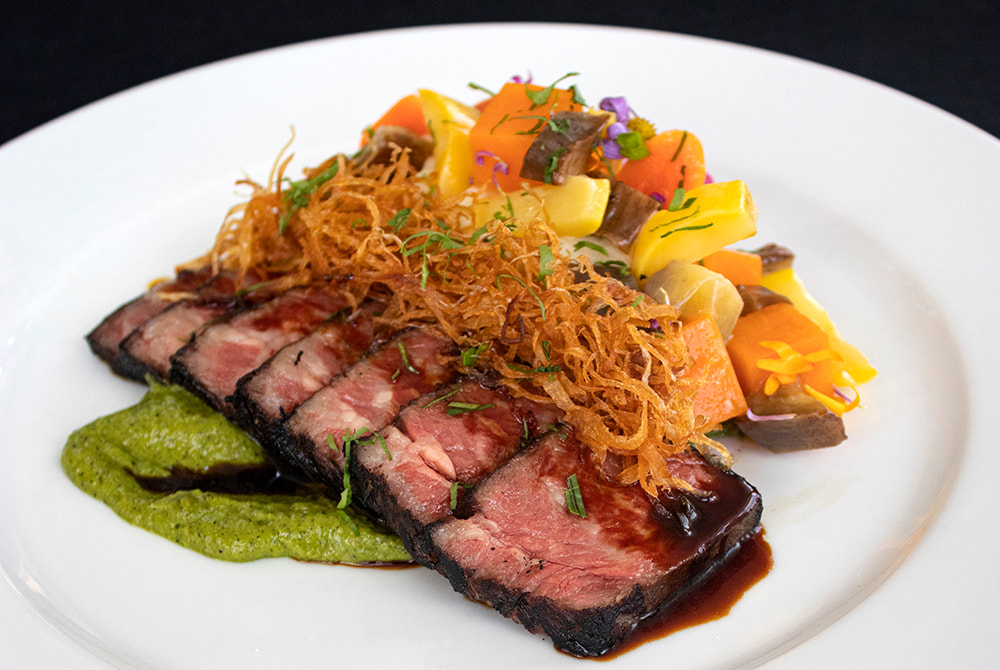 Recipe by Thomas Isidori, Executive Chef at Brae Burn Country Club, Purchase, New York, USA Image by Diana DeLucia Yield: 4 Components Cast Iron Seared Wagyu Denver Steak Whipped Potatoes Vegetable Medley Eel Sauce Chimichurri Crispy Shallots Ingredients Cast Iron Seared Wagyu Denver Steak
Whipped Potatoes
Vegetable Medley
Unagi (Eel Sauce)
Truffle Chimichurri
Crisp Confit Shallots
Garnish
Preparation Cast Iron Seared Wagyu Denver Steak Super trim the Denver steak. Chef Note: You should be left with a portion approximately 2 inches x 4 inches. The cutting side should be the 2-inch side (against the grain). Place the meat in a bowl, add the soy sauce and olive oil (50 / 50), and season with fresh thyme and salt and pepper. Place each steak in a small-sized vacuum bag and vacuum pack. Let sit for 24 hours under refrigeration. Set up a circulator at 128°F, place the vacuumed sealed meat in, and leave it for 4 to 6 hours. Chef Note: If reserving for a later date, remove after 4 hours into an ice water bath for later service. If using at pick up, remove the bag from the circulator, cut open, remove meat to a sports towel, and pat dry. Hard sear on all 6 sides and let rest until serving. Whipped Potatoes Rinse the cut potatoes and place in an ample amount of water that has been well-salted. Bring to a simmer and cook for 12 minutes or until potatoes are soft. In a saucepan add the milk, garlic, thyme and 3 ounces of butter, and bring to a simmer. Drain the potatoes from the water and discard the water. Chef Note: ensure the potatoes are well drained. Next, run the potatoes through a food mill set up with smaller holes into the pan that the potatoes were cooked in. Strain the seasoned milk through a fine mesh strainer. Add the milk to the potatoes one third at a time until you have achieved the proper consistency. Chef Note: It should look like buttercream. Hold for service in a one-third pan on a steam table or warm area. Before serving, re-whip the potatoes with the remaining butter at room temperature. Vegetable Medley Place all ingredients into a vacuum bag and seal. Place in a circulator with the beef 1.5 hours before serving. Just before serving, open the bag, place the vegetables into a medium hot sauté pan, and toss and adjust the seasoning. Unagi (Eel Sauce) Place all ingredients into a heavy-bottom saucepan and bring to a boil. Once boiling, reduce heat to a simmer and reduce until the sauce has thickened to Nape Chef Note: Reducing by half achieves this. Once cooled to room temperature, place into a squeeze bottle for serving. Truffle Chimichurri Place everything in a Vitamix and purée until smooth. Adjust the seasoning and thickness with oil, salt, and pepper. Crisp Confit Shallots Place everything into a heavy-bottom saucepan (starting from cold). Bring up to a simmer, constantly stirring until shallots become golden brown and crisp. Remove the shallots from the oil, place them onto a ¼ sheet tray lined with a sports towel, and season with salt and pepper. Keep in a warm place until serving. Assembly Find the desired plate you will be using. Chef Note: Start with a dollop of chimichurri at seven o'clock on your plate and drag the back of your spoon to two o'clock. Next slightly off the center of the plate, place a 3-ounce quenelle of the whipped potatoes. Place the vegetables in a decorative pattern on top of the whipped potatoes. Slice the beef in ¼-inch slices against the grain and shingle in front of the potatoes. Next, on top of the beef, but touching the potatoes and vegetables, place a generous amount of shallots in a line. Garnish the top of the vegetables and shallots with micro flowers and the chiffonade of parsley. Finish with the eel sauce right over the beef. 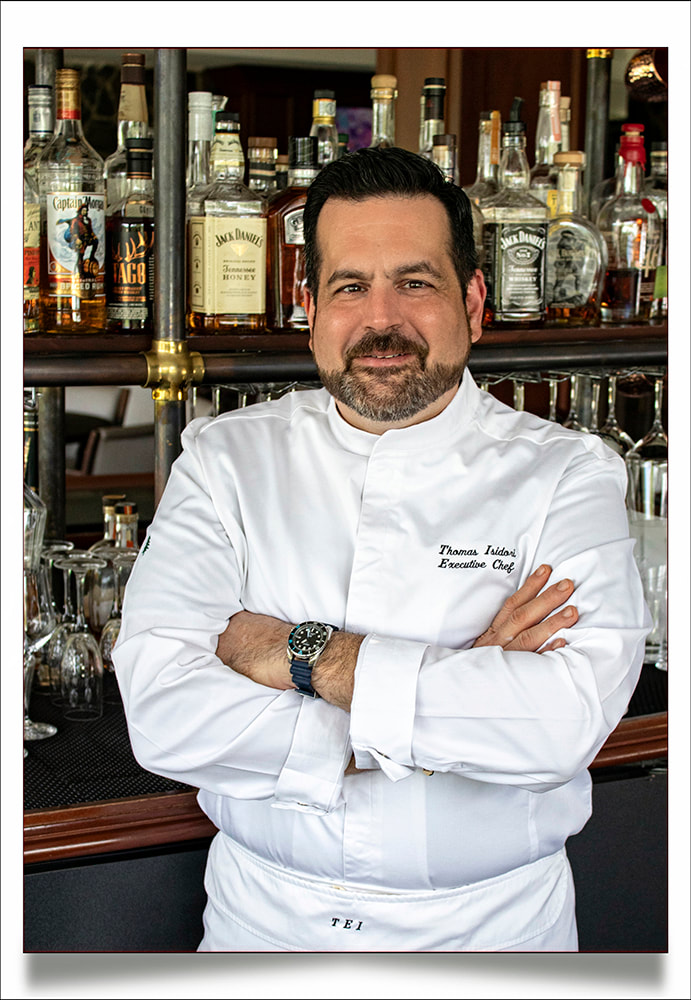 Thomas Isidori, Executive Chef at Brae Burn Country Club, Purchase, New York, USA
Image by Diana DeLucia 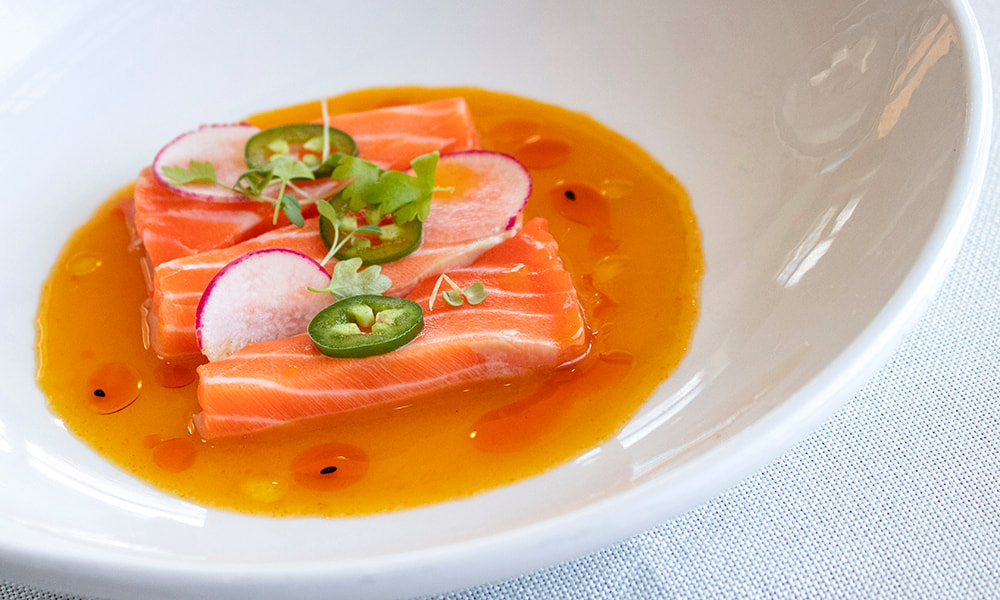 Recipe by John Trano, Sous Chef at Waccabuc Country Club, Waccabuc, New York, USA Image by Diana Delucia Serves: 4 Ingredients
Garnish
Preparation Set a fine mesh strainer over a large bowl or measuring cup. Set aside. Add the lime juice, veg stock, onion, garlic, celery, ginger, cilantro stems, ají limo paste, and ⅔ cup cold water to a high-powered blender. Blend until the mixture is completely liquefied, about 5 minutes. Add the salt and ⅓ cup ice cubes, then blend until thoroughly combined, 30–60 seconds more. Strain through the fine mesh strainer, reserving the liquid and discarding any solids. Chef Note: Cover and refrigerate the leche de tigre until ready to use, up to 1 day, or freeze for up to one month. Assembly Using a sharp slicing knife, slice the salmon into thin slabs. Arrange slices on your plates. Spoon sauce on top of the salmon, lightly coating it. Chef Note: Reserve any remaining sauce for another use. Garnish with a slice of red radish, jalapeños, chili oil and cilantro. 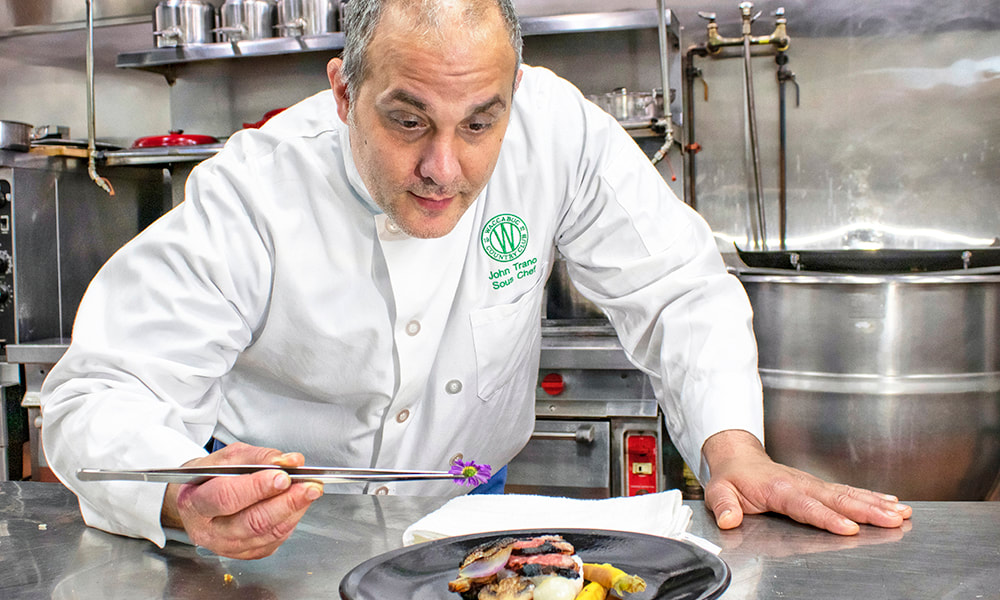 John Trano, Sous Chef at Waccabuc Country Club, Waccabuc, New York, USA
Image by Diana DeLucia 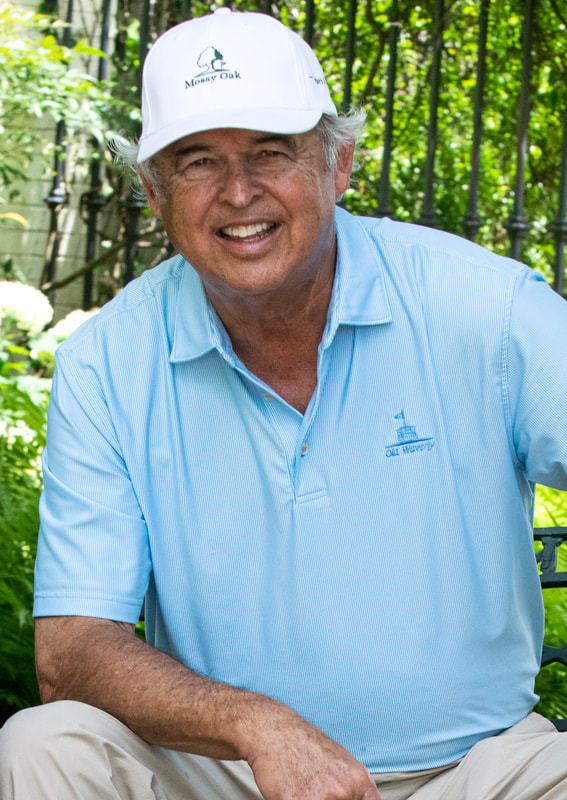 I write this not only for myself but to honor a Southern businessman and gentleman who, along with his family and community treated me with great respect and kindness.
In 2015 I was among those fortunate to visit Old Waverly Golf Club for a few days when I was producing the Golf Kitchen coffee table book. That was quite a life-changing experience for me; being an Australian, this was my first experience with deeply rooted Southern hospitality. From the moment I stepped into the world of George W. Bryan, Sr., in Westpoint, Mississippi (like everyone on the property), I was treated like a family member. Mr. Bryan and his equally kind wife and life partner, Mrs. Marcia Bryan, were so kind to me, and during my visit, I noticed that this was a priority and a deep part of who they were. George and his team were creating a new golf property nearby called Mossy Oak which was dirt, mud, and grass to me at the time! I am pretty curious by nature, and I was thrilled when George personally took me in a golf cart (one meant for muddy conditions) on a tour of the entire property; I was fascinated to learn how everything was created with such thought and care for the environment and how scientific it was, I was never to look at a golf course the same way again! Renowned golf course designer Gil Hanse and his team were installing the watering and irrigation system, which was eye-opening for me. That evening, I was treated to a sit-down wine dinner with George, Marcia, and their guests that the Memphis Wine Society was hosting at the club. The concept was brilliant. The selected members would bring all the wines for dinner, they each planned them with the culinary team, and each had to personally stand up and explain to the guests why they had selected that wine to pair with the menu item. Laughter was the order of the evening, and this was presented with an attentive staff who were all expertly delivering a flawless synchronized service. As the night progressed, you can only imagine how much more amusing and elaborate these wine stories became. I am still Facebook friends with a few folks from that evening, and whenever I see a post, it reminds me of that old worldly evening, like I was transported back into time, how I loved that tremendous Southern experience. George insisted that I tour the town of Westpoint; one of the highlights was Waverly Mansion. As a fan of history, this property had it all. It is a monument to a glorious time in Southern History, and the club is named after it. https://www.wpnet.org/index.php/attractions/waverly_mansion Another notable memory is George and Marcia's passion for historical art; historical artworks were everywhere in the Old Waverly Clubhouse, and I was mesmerized by them. Marcia gave me a personal tour of the family home to experience the historical artifacts and paintings they collected over many years; it was astounding. I was at Old Waverley to learn about the cuisine at Old Waverley,, but I got much, much more than I could have ever have imagined. Even after I returned to Connecticut, I was thrilled that I could run my ideas by George, and he would call back and entertain my visions. I am proud that my book sits in the Old Waverly clubhouse and to have been a small part of the culinary history of Mr. Bryan's treasured property. My deepest sympathies to Marcia and family, the entire Old Waverly team and membership, the Westpoint community, the golf community, and all those who the greatness of this incredible southern businessman and family man has touched. RIP ~ Diana DeLucia Grilled Bronzini with Quinoa Tabbouleh, French Feta, Heirloom Tomato Relish and Pomegranate Molasses1/6/2023 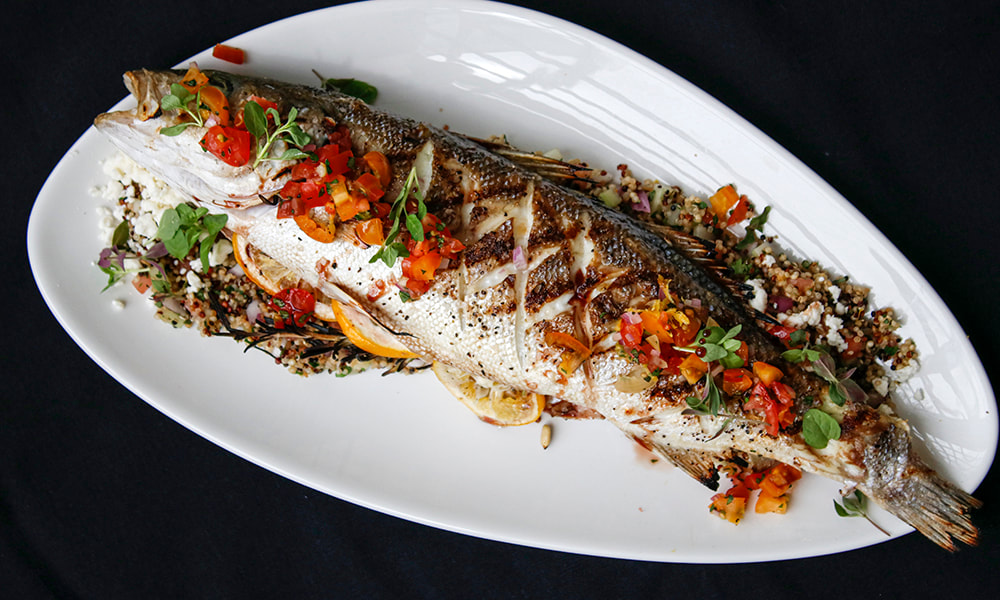 Recipe by Anthony Capua, Executive Chef at Sycamore Hills Golf Club, Fort Wayne, Indiana, USA Image by Diana DeLucia Serves 2 Ingredients Grilled Bronzini
Quinoa Tabbouleh
Heirloom Tomato Relish
Pomegranate Molasses
Garnish
Preparation Grilled Bronzini Take the Bronzini and stuff the interior cavity with sliced lemons, thyme, and rosemary. Chef Note: Be sure to pack it tightly. Next, score the skin with a boning knife, gently rub the extra virgin olive oil on both sides, and place it on the grill. Quinoa Tabbouleh Bring the quinoa, salt, and water to a boil in a medium saucepan over high heat. Reduce heat to medium-low, cover, and simmer until quinoa is tender (about 10 minutes). Remove from the heat, cover, and let stand for five minutes. Meanwhile, whisk the lemon juice and garlic in a small bowl. Gradually whisk in olive oil—season dressing to taste with salt and pepper. Spread out quinoa on a large rimmed baking sheet; let cool. Transfer to a large bowl; mix in 1/4 cup of dressing then add the cucumber, tomatoes, herbs, and scallions to the bowl with the quinoa; toss to coat. Finish with seasoning. Heirloom Tomato Relish Place 1/2 teaspoon coarse salt on a work surface and garlic cloves on top of the salt. Chop cloves into the salt, alternating with mashing the cloves into the salt with the flat part of the knife until you have a fresh garlic paste. Transfer the garlic paste to a medium-sized bowl. Chop the tomatoes, olives, and jalapeños and add to the bowl. Add the rest of the ingredients to the bowl and gently toss to blend. Season with more salt and pepper if desired. Pomegranate Molasses Reduce the pomegranate juice in a small pot on medium heat. After about 10 minutes, add the sugar and lemon juice and stir until dissolved. Chef Note: observe as pomegranate juice reduces by half and turns into a syrup in about 30-45 mins. Once pomegranate juice has turned to syrup, take it out of the pot, place it in a quart container, and keep it in the refrigerator. Assembly Take a long horizontal plate, place tabbouleh linear across the plate, and crumble three teaspoons of french feta on top of the tabbouleh. Place the Bronzini on top of tabbouleh and feta, lightly garnish with heirloom tomato relish, and finish with a light sauce of pomegranate molasses. Wine Match Chateau de Sancerre Blanc 2020, Loire, France You have a the sweet flesh of a fish, a little savory note, a little toast from the gill. I think about squeezing a lemon over it: I always go for a light, citrusy wine. That is a nice contrast to those smoky flavors. I will go with a a great Sencerre that I pour all the time. ~ Alfredo Hildebrandt, Assistant General Manager with sophisticated flair for fine wines and spirits.   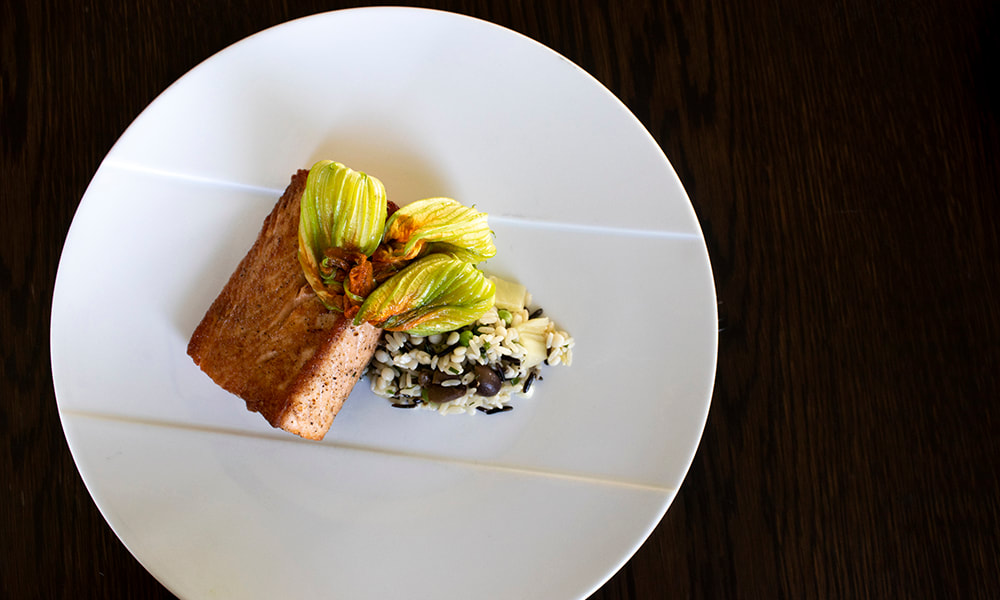 Recipe by Chrissie Bennett, Executive Chef at Winged Foot Golf Club, Mamaroneck, New York, USA Image by Diana DeLucia Yield: 4 Ingredients
Wild Rice
Garnish
Preparaton Season the salmon with salt and a few grinds of pepper. Heat the oil in a 12-inch nonstick skillet over medium-high heat until hot and shimmering. Cook the salmon, without moving, skin side up, until golden and crisp, about four minutes. Carefully flip the fillets and reduce the heat to medium. Continue cooking until done to your liking, four to five minutes more. Wild Rice Cook the rice using broth instead of water. When the cooking time is up, do not open the lid; turn the heat off and keep the lid tightly covered for ten minutes to allow continued steaming. If the rice is too firm, mix in just enough extra broth to moisten all the rice, cover, and simmer for another ten minutes. While the rice is cooking, add the butter to a large/deep skillet over medium-high heat. Once the butter is melted and starting to bubble, add the olives and English peas. Stir to combine. Cover and cook five minutes, stirring occasionally. Add the brussels sprouts, garlic, Italian seasoning, and black pepper, stirring for another two minutes until softened. Check rice for doneness. Fluff with a fork and add to a skillet with vegetable mixture, stirring to incorporate. Taste and season with kosher salt and freshly ground black pepper as needed. Assembly On a serving plate, spoon the wild rice in the center, place the salmon on top and garnish with zucchini blossoms. Wine Match Camaraderie Cellars Cabernet Franc, Columbia Valley, WA Nice and earthy with hints of cherry fruit running through it, notes of truffle and mushrooms, very Bordeaux-ish, nice finish. It pairs well with this grilled Roasted Salmon recipe.   Winged Foot Golf Club, Mamaroneck, New York, USA
Image by Larry Lambrecht, courtesy Winged Foot Golf Club "When Chrissie Bennett arrived at Winged Foot Golf Club in 2012 I never expected her to rise to the position of executive chef. Her rise to this position is a story of persistence, innate ability to develop delicate but complex flavor profiles, and unrelenting charm. Chrissie has demonstrated without question that there is no substitute for hard work. We are most proud to have Chrissie Bennett as executive chef of one of the most famous golf clubs in the world." ~ Colin A. Burns, General Manager 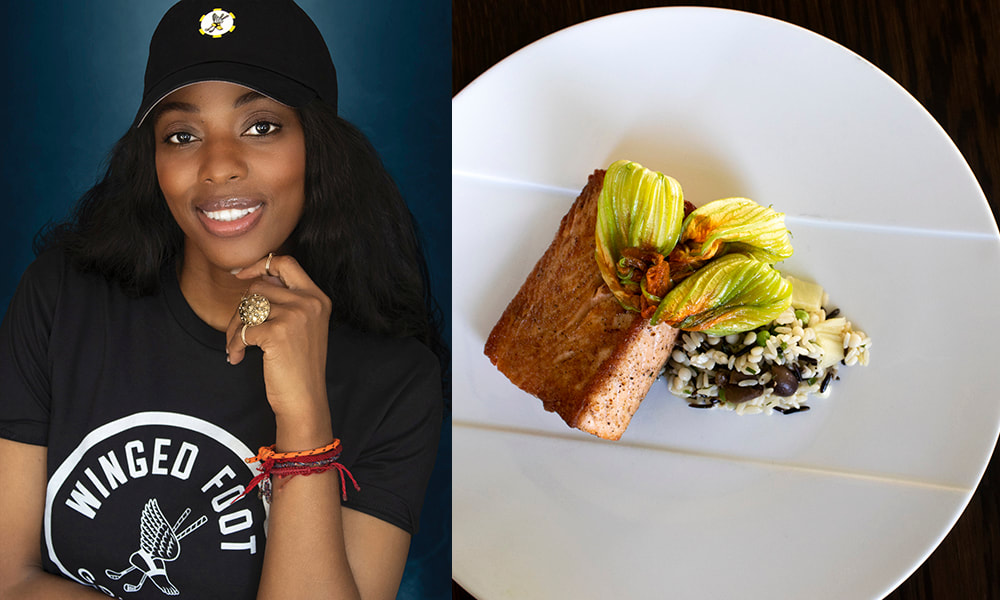 Left: Chrissie Bennett, Executive Chef at Winged Foot Golf Club. Right: Seared Salmon with Wild Rice and Zucchini Blossoms. Images by Diana DeLucia In 2014, I interviewed Chrissie Bennett when she was the Kitchen Manager at Winged Foot Golf Club, and I asked her this question. Where do you see yourself in five years? “Hopefully, in an executive position, and most likely in a sous chef position. I love Winged Foot so much that I am happy to work my way up here and have no intentions of leaving. I am very family-oriented, and Winged Foot feels like home, which is why people stay here for 20 years and more. We’re always thankful that members and management acknowledge our performance, which happens every day! To summarize my feelings, Winged Foot has been great to me, and I, in turn, need to be great for Winged Foot.” It is an honor and a privilege to return to Winged Foot and to witness this fierce Jamaican-born young woman from the Bronx take on one of the most significant culinary roles in the industry. ~ Diana DeLucia GK: Tell us when you realized that cooking inspired you? My parents both worked, and they took turns cooking dinner. One rainy day when I was around 11 years old, I called my mom and told her I wanted to cook something to eat. She said, “No, you are too young, and you don’t know what you are doing!” I replied, “Fine, I won’t do anything,” and then I said, “Mom, I am going to cook something!” Defiantly I went to the kitchen, opened the fridge, and made Chicken Curry with White Rice. When my mom came home from work, she was impressed and started calling everyone to tell them how her little Chrissie had cooked an impressive meal. That is when I knew I was interested in cooking, and after that, you couldn’t stop me! I cooked for my family, school friends, and at any opportunity, I could. Both my parents could cook, especially on my father’s side, so you could say it’s in my DNA, my family’s genes! My extended family is enormous, and I have many Aunts, Uncles, and Cousins. I credit my family for showing me that cooking was a pleasurable activity, and to this day, I love it, whether cooking for two or 200! You can always teach someone the cooking techniques, but you can’t teach the commitment and passion needed to excel. GK: Tell us about your journey to one of the top Executive Chef positions in the country. When I first came to Winged Foot 11 years ago, it was just a Summer job. Unexpectedly, I fell in love with the place. I felt it; it was so different, and I loved the culture and began to make friends. My first duties here were at the pantry station. I think everyone was surprised that I knew what I was doing; besides cooking for family and friends, I used to watch every culinary show in existence for hours. I would have my notepad and jot down everything; cooking became my second nature! By my third year, I was the kitchen manager. When our former Executive Chef, Rhy Waddington, moved on in 2021, I accepted the role. I knew I was ready. GK: Winged Foot has been a great learning environment for you. Tell us about that. Many people don’t realize that it is much harder to attain recognition at a private club, but the goal is there if you want to work for it. At Winged Foot, you learn much more than you would in a restaurant because you have breakfast, lunch, banquets, fine dining, events, weddings, and golf course food. There’s so much more education in the private club space. Another great thing about this learning environment is that you have more freedom to be creative. Due to the number of oversized banquets and events, I can take traditional recipes, play around with the ingredients and find new ways to present them. I love that freedom. Winged Foot has pushed me to be the best version of myself. The only way I could conquer Winged Foot, one of the most beautiful and fierce animals you can come across, was to be just as fierce! GK: You sacrificed a lot on your journey. Tell us about that. I knew how much I had sacrificed to get to this position. If I came here every day, not giving my all, would it be worth all the sacrifices? When I accepted this role, I took it very seriously. I’m a person who, if I dedicate myself to something, I’m going to work hard at it. As a woman of color in this male-driven career, I have grown a thick skin and learned much from the harshest criticism. The most significant personal sacrifice I made during my journey to this position was missing my sister Tanya Bennett’s graduation in Italy. We are very close, and every time I feel low, I think about the moment I made that choice and how it has paid off. It helps me to push through hard times. GK: What was the biggest challenge when you took on this role? When I took this role, I took it very seriously. I’m a person who, if I dedicate myself to something, I’m going to work hard at it. As a woman of color in this male-driven career, I have grown a thick skin and learned much from the harshest criticism. Creating a team is such a difficult task. One of the most challenging struggles is taking over a group of staff that the former chef led. Getting people who have worked under someone else to accept your vision isn’t an easy task. You have to figure out new ways to separate yourself from those who were previously on the same level and then get them to buy into your ideas and goals. That is not always possible, and that’s when hard decisions have to be made. You ask yourself, how do you create a culture with rotten apples? GK: How do you lead your team now to build a better culture? One thing I love to do is team building. I try to build each person up and encourage them to do their ultimate best. I talk with them daily about the service at the end of the shift. I give credit all the time. I’m honest and open with my staff and show them their strengths. I try my best to enable them to be creative. On the flip side, I might have a team member with an elevated ego, and I need to find a way to bring them back to earth, then rebuild. When I first got this promotion, I received a letter from a girl congratulating me. I did not remember who she was. In the letter, she reminded me about a day many years earlier when she was feeling down and was in need of a little encouragement. She told me that my words made such an impact on her life. It is mind-blowing that she tracked me down years later, congratulating me. It was just a conversation at the bottom of the Winged Foot staircase. This made me realize how important words are. GK: You may not realize it, but you are a light for many people here. Thank you! This moment is so unbelievable for me. Who would have thought getting this promotion would have touched so many individuals, both young and old? I wanted this position for myself at first; I wanted Winged Foot. I have put so much of myself into it. However, when I was given the new role and started receiving congratulatory messages from so many people in and out of the industry, I realized what a huge accomplishment it was. It would be fantastic for my story to go as far as God wants to take it. Words can’t explain how important it would be to me personally if I were to be an inspiration to even one person. GK: How has the membership responded to your new role? I am overwhelmed by how supportive the membership has been. Rhy was here for ten years, and the members loved him; they were big shoes to fill. I knew some members wanted this for me, but the support has been much more than I had anticipated. It has made me want to do better. That’s the beauty of it. That’s why I come here every day. I want to know when someone eats my food; I want them to be blown away by it. I see this place as my extended family; I need them just as much as they need me. GK: Tell us about some people who have influenced your career. The relationship I have built with Mr. Colin Burns, our General Manager, is phenomenal. He’s been behind my back this entire time. Chef Rhy realized 11 years ago how dedicated I was, and they have both championed my development. My father always instilled in me that I could achieve anything if I had a dream or desire, worked hard enough, and made sacrifices along the way. I want to bring more people into my surroundings. If I can get people to come into this kitchen, I can show them that what you put into a club is what you will get back. GK: From my perspective, the younger club chefs are creating new ways to run kitchen operations, especially in the last few years of the pandemic. It is not based on the old-style brigade system anymore. At Winged Foot, we have workers of all different age ranges. It’s hard to get everyone to buy into the angry brigade atmosphere. There will always be some tension because we all work so many hours, and we must try to create the best environment, so people want to be here. GK: How do you manage the mental health of your team? There’s so much happening in a person’s day-to-day life that we don’t know. I talk to everyone I hire, try to get to know them personally, and build a better working relationships. We all come from different walks of life. I come from a solid background, and I can honestly say that not everyone comes from that. It doesn’t matter how well someone looks or presents themselves; there might be some real deep-rooted stuff that’s happening outside of work. I try to figure out how to connect with all my staff and encourage and motivate them. If someone struggles from within, I need them to feel comfortable talking to me about it. Our kitchen is a very stressful environment, and the expectations are high. We’re not saving lives; we’re just making food, but at the same time, everyone needs to receive approval from their peers, superiors, and members. You put so much of yourself into this kitchen. It becomes a massive part of your life, so I need to make it as supportive of an environment as possible. GK: How do you think we can raise more awareness of the culinary career opportunities that the industry provides? I honestly believe we have to figure out what we can do as an industry. Each person has to do their part to come up with a system that works long-term. We need to begin by inspiring young children and teenagers. GK: How do we make future culinarians learn about the culture of our industry and all it has to offer? I hope a face like mine will bring that awareness to many.  Winged Foot Golf Club, Mamaroneck, New York, USA
|

|